I launched HexaXpress in December 2025 and expected Google to discover the website within the following weeks. The site was live, its pages were published, and the basic SEO setup appeared to be complete. However, after nearly three months, the website was still not appearing properly in Google Search.
At first, I treated this as a waiting problem. New domains can take time to be discovered, crawled, and indexed, especially when they have few external links. But as the delay continued, waiting stopped being a reasonable strategy. I needed to determine whether Google was simply taking its time or whether something was preventing it from accessing and understanding the website.
This became a practical technical SEO investigation into domain accessibility, DNS configuration, crawl signals, Search Console, and sitemap discovery.
The Problem I Was Investigating
The initial problem was straightforward:
Why was a live website still not appearing in Google after several months?
There are several stages between publishing a page and seeing it in search results. Google must discover the URL, access it, crawl it, process its content, select a canonical version, and decide whether to index it. A failure at any of these stages can keep a page out of search.
That meant I could not assume that the content was the problem. I first needed to confirm that the domain and its important pages were consistently accessible.
My Initial Hypothesis
My working hypothesis was that Google was either having difficulty reaching the website or was not receiving sufficiently clear crawl and indexing signals.
To investigate, I reviewed:
- Domain and HTTPS accessibility
- DNS resolution
- Nameserver configuration
- A and CNAME records
- robots.txt rules
- Meta robots directives
- Canonical tags
- XML sitemap availability
- Google Search Console verification
- URL Inspection results
This was not a controlled experiment in which I changed one variable while leaving everything else untouched. It was a retrospective diagnosis of a live website, and several connected areas had to be checked and corrected.
What I Found in the DNS Configuration
During the investigation, I identified issues in the domain’s DNS setup. I corrected the nameservers, the root-domain A record, and the CNAME record used by the www version of the domain.
Each record has a different responsibility:
- Nameservers determine which DNS provider is authoritative for the domain.
- The A record points the root domain to the web server’s IP address.
- The CNAME record connects a hostname such as www to the intended canonical domain or destination.
If these records are incorrect or inconsistent, users and crawlers may not always reach the intended website. One hostname may load while another fails, or the domain may point to the wrong hosting environment.
DNS is not a direct ranking factor, and changing DNS does not force Google to index a website. Its relevance here was more fundamental: Googlebot must be able to resolve the domain and access the server before it can crawl a page.
The Five-Step Diagnosis Process
1. Verify accessibility
I checked whether the root domain, www version, HTTPS version, and important pages loaded successfully. This helps reveal DNS failures, redirect loops, certificate errors, and server problems.
2. Inspect DNS
I reviewed the active nameservers, A record, and CNAME record. I then corrected the configuration so the domain consistently pointed to the intended hosting environment.
3. Check crawl signals
I reviewed robots.txt, meta robots directives, canonical URLs, and server responses. An accessible page can still remain out of the index if it carries a noindex directive, points to a different canonical URL, or returns an incorrect status code.
4. Set up Search Console and submit the sitemap
After confirming accessibility, I verified the domain property in Google Search Console and submitted the XML sitemap. A sitemap helps Google discover important URLs, although submission does not guarantee indexing.
5. Inspect, request, and monitor
I used URL Inspection to test important pages, requested indexing where appropriate, and monitored the Page Indexing and Performance reports for changes.
What the Available Evidence Shows
I did not capture screenshots of the incorrect DNS records when the issue occurred. Therefore, I cannot present a direct before and after comparison of every record. Instead, I collected the evidence still available in the Search Console and the current DNS configuration.
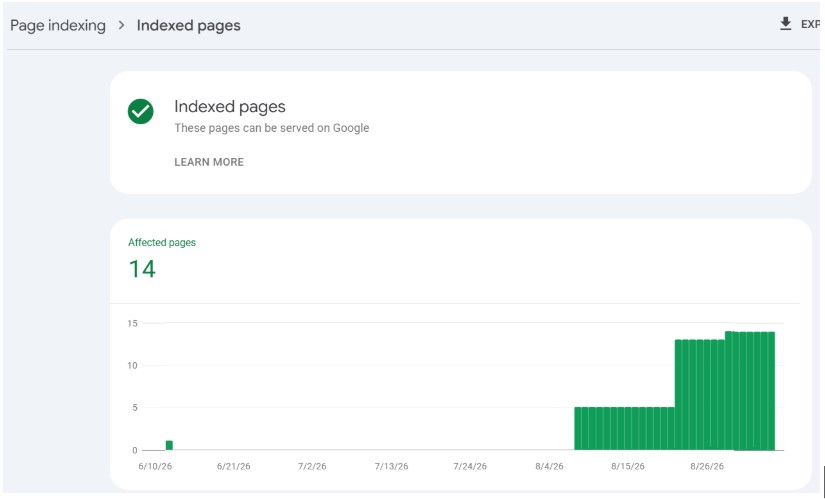
The Page Indexing report showed that the site eventually reached 14 indexed pages. The graph indicates that approximately five pages were indexed in early August 2026, followed by an increase to approximately 13 to 14 pages later that month.
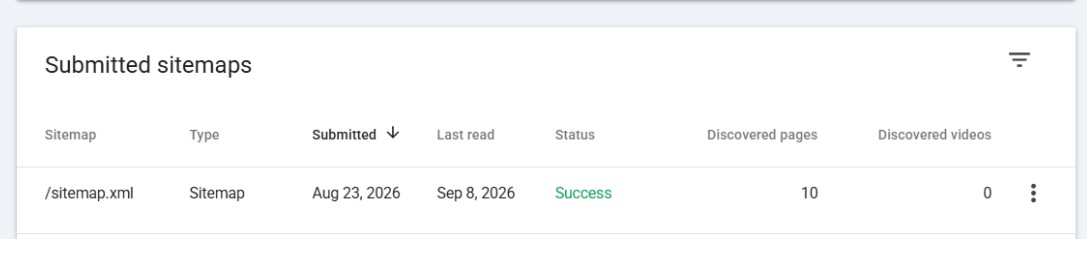
The XML sitemap was submitted on August 23, 2026. Search Console recorded it as successfully processed, with 10 discovered pages, and showed that it was read again on September 8.
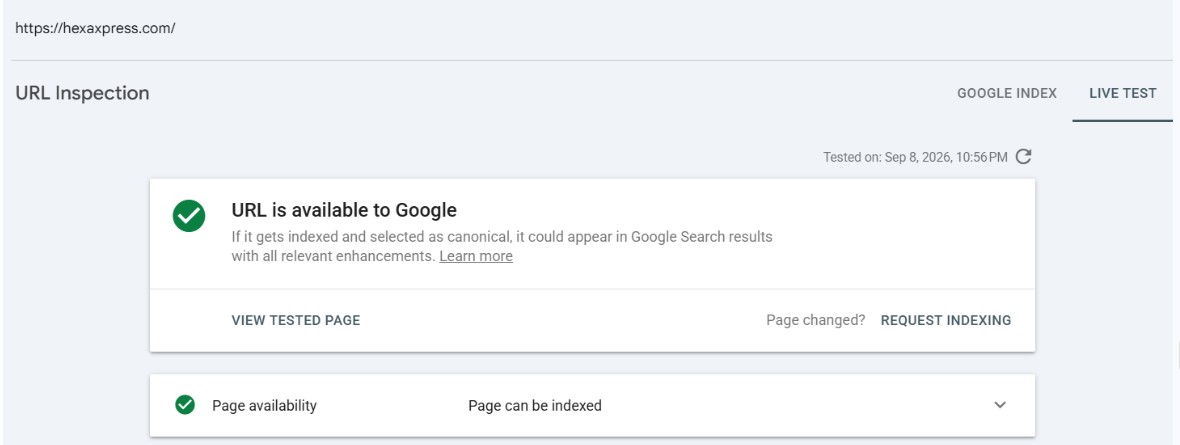
A live URL Inspection test performed on September 8, 2026 reported that the homepage was available to Google and could be indexed. This confirmed that Google could access the homepage successfully at the time of testing.
The Performance report for the displayed August period recorded:
- 45 impressions
- 2 clicks
- 4.4% click-through rate
- Average position of 51.7
- Capture the original DNS records before making changes.
- Record the exact date and time of each change.
- Test the root, www, HTTP, and HTTPS versions separately.
- Save URL Inspection results before and after the correction.
- Export Search Console indexing data at regular intervals.
- Change one variable at a time where practical.
- Monitor DNS propagation and server logs, if available.
- Does the domain resolve correctly?
- Do all preferred hostname and protocol versions reach the right website?
- Does the server return a successful response?
- Is crawling permitted?
- Are the canonical and indexing directives correct?
- Can Google discover the pages through internal links and the sitemap?
-
These are modest numbers, but they are meaningful for a new site. They confirm that pages had started appearing in Google Search and receiving visibility.
What I Can and Cannot Conclude
The evidence supports the following conclusion:
After correcting the domain’s nameservers, A record, and CNAME configuration, I confirmed that the website was consistently accessible. I then verified Search Console, submitted the sitemap, inspected important URLs, and monitored indexing. In the following period, the number of indexed pages increased and the site began receiving search impressions.
However, the evidence does not establish that DNS was the only cause of the improvement. I corrected multiple DNS records and completed additional indexing actions during the same broader investigation. Because I did not preserve the earlier DNS state or change only one variable at a time, I cannot isolate the effect of each action.
This distinction matters. A practical SEO investigation should explain what the evidence demonstrates without claiming more certainty than the data allows.
What I Would Do Differently Next Time
If I repeated this investigation, I would document every stage:
That documentation would make it easier to connect a specific technical change with a measurable crawling or indexing outcome.
The Main Lesson
My biggest mistake was initially treating the indexing delay as a waiting problem. The more useful question was not, “How much longer should I wait?” It was, “Can Google consistently access, crawl, and understand this website?”
When a new website remains unindexed, the investigation should begin with the technical foundation:
Only after confirming these fundamentals should content quality and authority be assessed as possible reasons for exclusion.
Final Takeaway
Correcting DNS did not guarantee indexing. It helped remove a possible accessibility barrier. Search Console verification, sitemap submission, URL inspection, crawlability checks, and continued monitoring were also part of the process.
The broader lesson is simple: when indexing does not happen, do not rely on repeated submission or passive waiting. Start with the problem, follow the evidence, correct the technical foundation, and measure what changes.